
Healthcare facilities carry a storage obligation that sits at the intersection of patient safety, regulatory compliance, and daily operational efficiency. Get the infrastructure right and clinical staff can focus on care. Get it wrong and the consequences range from failed audits and WHS liability through to medication diversion incidents and infection control breaches.
The challenge is that healthcare storage decisions are often made under time pressure, from catalogues built for general commercial use, by teams who need suppliers to understand their environment without needing it explained at length.
See how we can support your facility with our product range suited for the healthcare industry.
The Storage Problems That Keep Surfacing
Most healthcare storage failures are not dramatic. They accumulate. A trolley castor that starts catching on floor transitions. A cabinet finish that begins lifting after six months of daily disinfectant contact. A locking mechanism that becomes unreliable, sits on the maintenance list for months, and eventually creates a compliance gap. A chemical store that grew organically over time and now holds substances that should not be stored together.
These are failures of specification. Products purchased without a clear understanding of the environment they are going into, or without the right questions being asked of the supplier beforehand.
The facilities teams that avoid these problems consistently do a few things differently:
- They specify for worst-case use, not average use
- They ask for material and finish data, not just product descriptions
- They work with suppliers who provide compliance documentation as part of the product, not as a follow-up request
Chemical and Hazardous Materials Storage
The segregation requirement is where many healthcare facilities are quietly carrying risk. Disinfectant concentrates, sterilisation chemicals, cytotoxic agents, and flammable procedure materials each sit in different GHS hazard classes. Safe Work Australia's incompatibility rules are clear: flammables, corrosives, and oxidisers need physical separation, and a single general-purpose lockable cupboard does not satisfy that requirement regardless of how securely it locks.
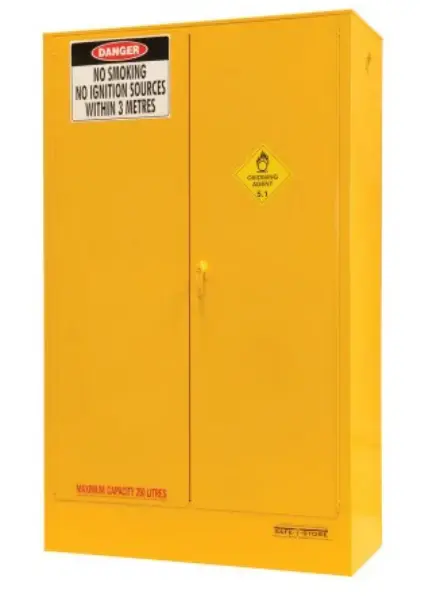
The 250L Chemical Storage Cabinet is built to AS 1940 compliance standards with double-walled steel construction, bunded base, self-closing doors, and appropriate ventilation provisions. It is the kind of product that can be pointed to in an audit with documentation ready, rather than one that requires a conversation about whether it meets the standard. For facilities carrying medium-to-large chemical inventories across central stores or satellite locations, it is worth reviewing whether every storage point holds up to the same scrutiny.
Controlled Substance and Medication Storage
Schedule 8 storage regulations require double-locked systems with documented key management and construction that resists forced entry. That last point matters more than it sounds: heavy-gauge steel built for this purpose is a different product category from a standard metal cabinet with a cam lock fitted to it.
When specifying medication storage, confirm the following with any supplier before committing:
- Steel gauge and frame construction, not just the locking mechanism type
- Whether the product meets the double-lock requirement as a standalone unit or requires installation within a locked room to satisfy the regulation
- Whether compliance documentation is supplied with the product and in a format suitable for an ACHS accreditation review
- Load capacity for the specific medications, trays, and equipment being stored
Secure Personal Storage for Staff
Staff working patient-facing shifts have a separate and practical need for secure personal storage. Phones, keys, and personal items need to be secured during shifts in environments where large numbers of personnel, contractors, and visitors move through the same spaces.
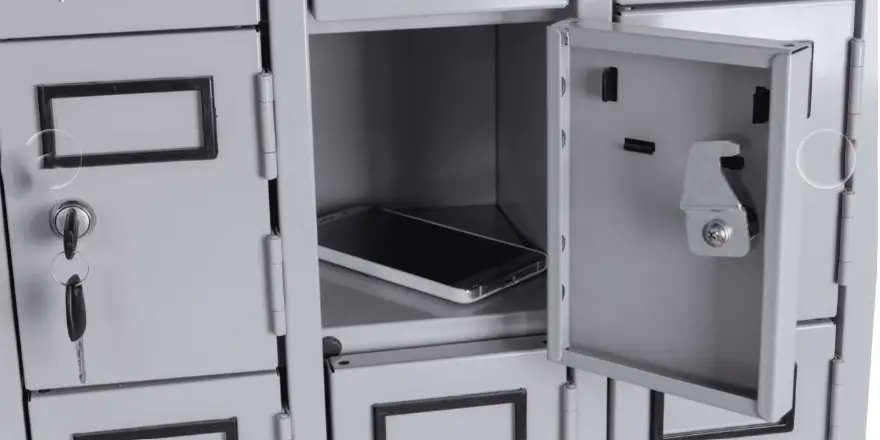
Our Phone and Keys Locker handles this in a compact footprint, available in 30 or 60 door configurations to match the headcount of the team area. Where staff require larger individual secure storage, Noxx Custom Lockers can be specified to exact dimensions and configurations for change rooms, staff bases, or any area where standard catalogue sizes do not fit the available space.
Surfaces That Hold Up to Clinical Cleaning Protocols
The most common surface failure in healthcare storage is powder coat that was not specified for chemical resistance. Hospital-grade disinfectants applied daily will eventually compromise a coating that was not tested against them. Blistering and chipping follows, and once a surface is compromised, it is harder to clean effectively and creates a contamination risk it was meant to prevent.
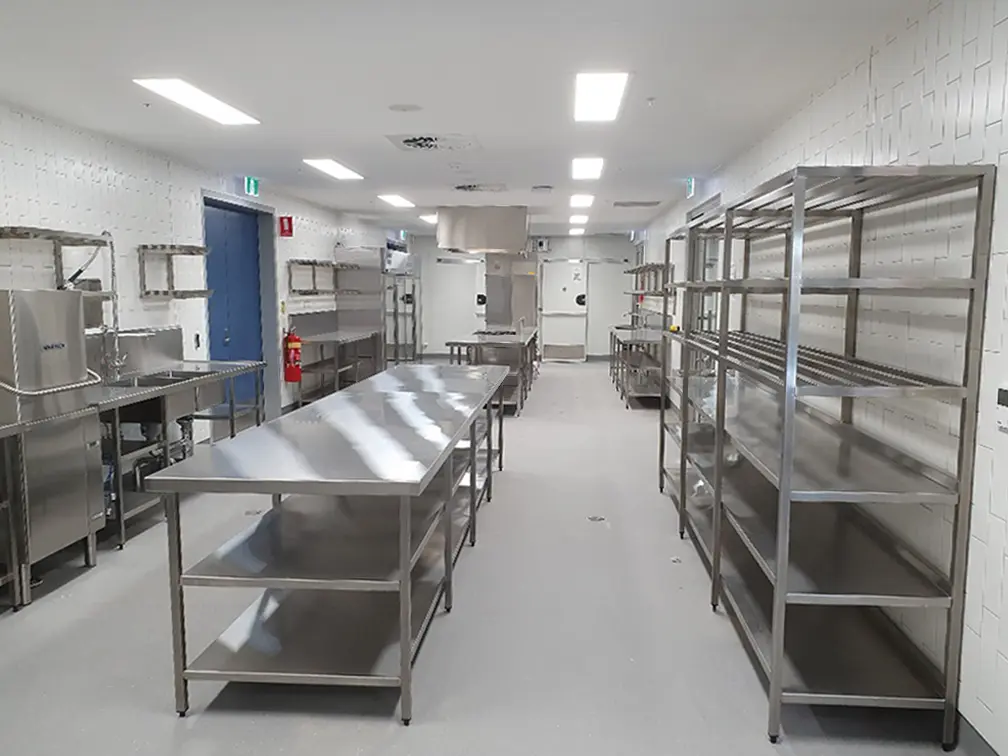
For high-exposure clinical zones including procedure rooms, sluice areas, scrub zones, and preparation areas, stainless steel removes the coating question entirely. Stainless Benches and Shelving is available custom-fabricated to the exact dimensions of the space. In healthcare environments where standard catalogue sizes rarely fit the room, and where cutting down a standard product leaves raw edges that compromise both hygiene and finish integrity, fabrication to brief is the correct approach rather than the exception.
For zones with lower disinfectant frequency, powder-coated steel remains appropriate provided the coating specification has been confirmed against the cleaning products in use. Any supplier should be able to provide that data before the quote is accepted.
Mobile Storage: Where Specification Gaps Show Up Fastest
Trolleys and mobile carts in healthcare environments fail in predictable ways when they are under-specified: castors that catch on threshold transitions or collect debris, load ratings exceeded by the actual content being transported, locking configurations that do not match the security requirement of the clinical area, and surfaces with tight internal corners that cannot be cleaned completely.
Noxx supplies mobile storage across a range of configurations relevant to clinical and facilities applications:
- 3-Tier Service Cart with Locking Doors provides enclosed, lockable storage across three shelves, suited to supply distribution rounds and clinical room restocking where security during transit is required.
- Cart with Basket suits linen, consumables, or waste management rounds where an open, easy-clean configuration is preferred over an enclosed design.
- For bulk supply movement through central stores, loading docks, and facilities logistics, the Multi-Purpose Platform Trolley and the Multi-Purpose 2-Tier Platform Trolley handle heavier loads across the mixed floor surfaces common in hospital buildings.
- Where compact manoeuvrability matters most, particularly in shared rooms or narrow ward corridors, the Easy Mover provides a low-profile option for moving equipment between positions without the turning radius of a larger trolley.
What to Confirm Before Committing to a Supplier
Healthcare procurement processes exist for good reasons, and storage infrastructure should go through the same scrutiny as any other clinical asset. Before committing to a supplier, confirm:
- Can they provide finish and material specifications, including chemical resistance data for the disinfectants used in the facility?
- Are load ratings documented and tested against relevant Australian standards, not estimated?
- Can they deliver custom dimensions without long lead times or high minimum order requirements?
- Is compliance documentation supplied as a standard part of the product?
- Are replacement parts available domestically, and for how long after purchase?
- Is the supplier's after-sales team based in Australia and reachable when something needs to be resolved?
How We Work With Healthcare Clients
We are an Australian manufacturer with production capability across metal fabrication, stainless steel, laminate furniture, and precision plastic components. The compliance focus and custom-design approach that has delivered fit-outs across NSW school environments, where WHS obligations, specific dimensional requirements, and high-obligation use are equally non-negotiable, applies directly to healthcare.
Products are built to the brief rather than adapted from a commercial catalogue. Compliance documentation is part of the product. Our team is based in NSW and accessible after the installation is complete.
Contact our team to discuss storage and infrastructure requirements for your facility. Call 1300 066 990 or visit our helpdesk.